
Parents rarely ask it directly, but it sits underneath a lot of conversations at training. How does a child get from a suburban Saturday morning to something more serious? Who decides, when does it start, and is our family already behind?
The honest answer is more reassuring than most people expect, and it starts with a piece of information that saves a great deal of unnecessary worry.
Under about 13, there is nothing to be selected for
Representative cricket in Victoria begins at roughly the under-14 level. Below that, there is no state pathway, no scouting, and no selection process that a child can miss out on.
This matters because families sometimes arrive convinced that a ten-year-old is already falling behind. They are not. There is nothing yet to fall behind in. The years before under 14 are for developing skills, enjoying the game and staying in it, which is a genuinely different objective from being selected.
It also means the common instinct to specialise early and train harder younger is working against a deadline that does not exist. Questions about how early children should start structured training are worth thinking through on developmental grounds rather than competitive ones, because the competitive clock starts later than most parents assume.
The actual entry point is your association
When representative cricket does begin, it happens through the association your club plays in, not through Cricket Victoria directly and not through any academy.
Metropolitan associations run representative competitions at the younger age groups, with country regions running their own equivalent. These are the introductory level of the talent pathway, and they are where a player first encounters cricket against other selected players rather than against whoever their club happens to be drawn with.
Selection into those teams comes from club performance. Association selectors watch club cricket, take recommendations from club coaches, and run trials. Which means the route into representative cricket runs directly through playing well for your club, and it is another reason that getting settled at a club matters as much as it does. If your family is still working out how club cricket operates in Melbourne’s north, that is the foundation everything else is built on.
What comes after that
From association representative cricket, the pathway continues into underage competitions aligned with Victorian Premier Cricket, the state’s highest level of club competition. Premier Cricket clubs also run their own development academy squads for emerging players in the older junior age groups.
Beyond that sit state emerging player programs, squads selected to represent Victoria at national championships, and ultimately state selection. Each stage narrows considerably, which is worth being clear-eyed about.
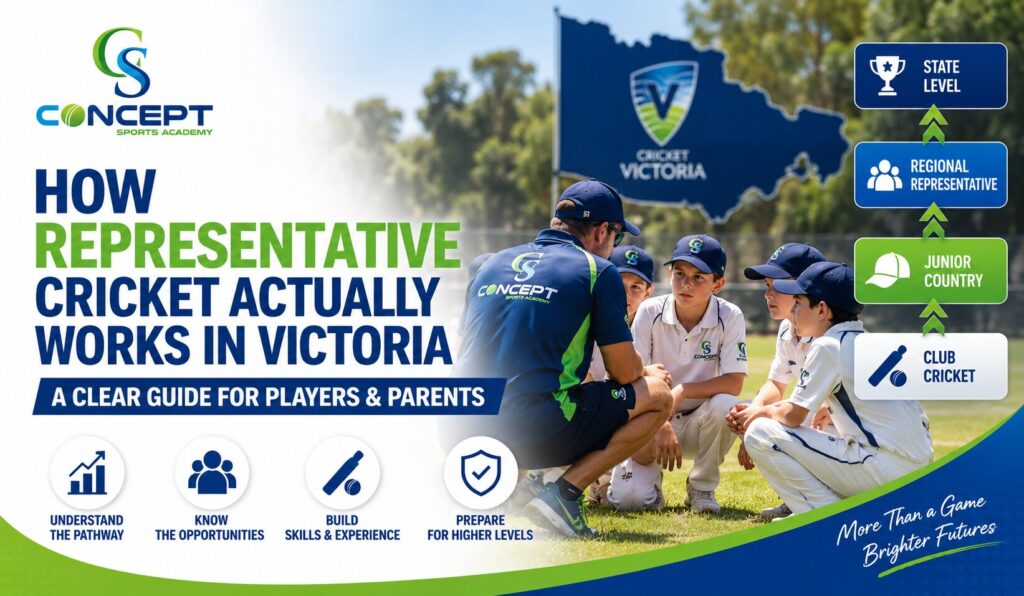
The shape is straightforward: club, then association representative, then underage Premier Cricket and state programs. Four broad stages, each selected from the one below.
Why you should ignore the competition names
Here is a practical warning that will save you confusion.
Cricket Victoria has restructured its junior pathway several times in recent years. Competitions have been introduced and then replaced, age groups have shifted, and the programs sitting at each level have been renamed and reorganised. A parent who learns the current competition names and treats them as fixed will be working from an outdated map within a couple of seasons.
What has stayed stable is the underlying route. Chase the structure rather than the labels, and confirm the current specifics on the Cricket Victoria player pathway page or with your own association rather than relying on what another parent told you last summer.
What selectors are actually looking at
Selection at junior representative level is less mysterious than it appears. Broadly, selectors are looking for players who can do something reliably against better opposition than they usually face.
- Bowlers who land the ball consistently, rather than those who occasionally bowl an unplayable delivery.
- Batters who score against good bowling, not those with impressive numbers built against weak attacks.
- Players who contribute in the field every match, which is the easiest way to be noticed and the most commonly wasted opportunity.
- Children who are coachable, listen, and do not fall apart after a failure.
That last point carries more weight than families expect. A selector choosing between two similar players will take the one who handles a bad day well, because the pathway involves a great many bad days against stronger opposition.
What genuinely helps, and what does not
The things that help are unglamorous. Playing regularly. Being available and reliable. Working on weaknesses rather than rehearsing strengths. Having a club coach who knows your child well enough to recommend them, which is far more likely if your family is involved rather than only dropping off and leaving.
What does not help is overloading a child in pursuit of a selection years away. Representative cricket adds significant time commitments on top of club cricket, and families who are already stretched before any of that arrives struggle when it does. Thinking early about how school and sport fit together is more useful than adding another weekly session.
It is also worth keeping perspective about where this leads. Very few junior cricketers become professionals, and a pathway framed entirely around that outcome sets most children up for disappointment. The case for a serious academy environment rests on what it does for a player’s development and enjoyment of the game, with representative selection as a possible outcome rather than the purpose.
Play well, play often, be someone a coach wants in the team. The pathway finds players who do that, and it starts later than you think.
FAQs
My child is ten and very good. Should we be doing something now?
Nothing selection-related, because representative cricket does not begin for several more years. What is worth doing at ten is building technique properly, playing as much as possible, and keeping the child interested in the game. Children who are pushed hard at nine and ten frequently lose interest before the age when it would have counted for something.
Does playing for a bigger or stronger club improve selection chances?
It can help, since stronger clubs sometimes have better coaching and closer relationships with association selectors. But a child who is playing well and enjoying a smaller club is usually better off there than struggling for a game at a larger one. Being visible and performing matters more than the badge on the shirt.
What if my child misses selection one year?
It is common and rarely final. Junior representative squads turn over substantially year to year as children develop at different rates, and a player who misses at under 14 may well be selected at under 15 or under 16. The children who drop out entirely after a rejection are the ones who genuinely lose the opportunity.
Are there separate pathways for girls?
Yes, Victoria runs parallel representative competitions and state programs for female players, with their own age groups and national championship squads. The age groups do not always mirror the male competitions, and the structure has been revised in recent years, so check the current arrangements with your association or Cricket Victoria directly.
Can an academy get my child into a representative team?
No, and any program claiming it can is misrepresenting how selection works. Academies have no role in selection decisions, which sit with association and state selectors. What good coaching does is improve a player enough that selectors notice, which is a real contribution but a different one from influence.
Unlock Your Full Cricket Potential
| We cannot select your child. We can prepare them.
No academy picks representative teams, and anyone suggesting otherwise is overselling. What structured coaching does is make a player harder to leave out: a bowler who lands it consistently, a batter who scores against good bowling, a fielder who never switches off. Selectors respond to that regardless of who coached it. If your child has ambitions beyond club cricket, we are happy to give you an honest read on where they are and what would help. Call 1300 310 769 or email info@conceptsports.com.au. We are at 1/16 Poa Court, Craigieburn VIC 3064. Program details at conceptsportsacademy.com.au. |