
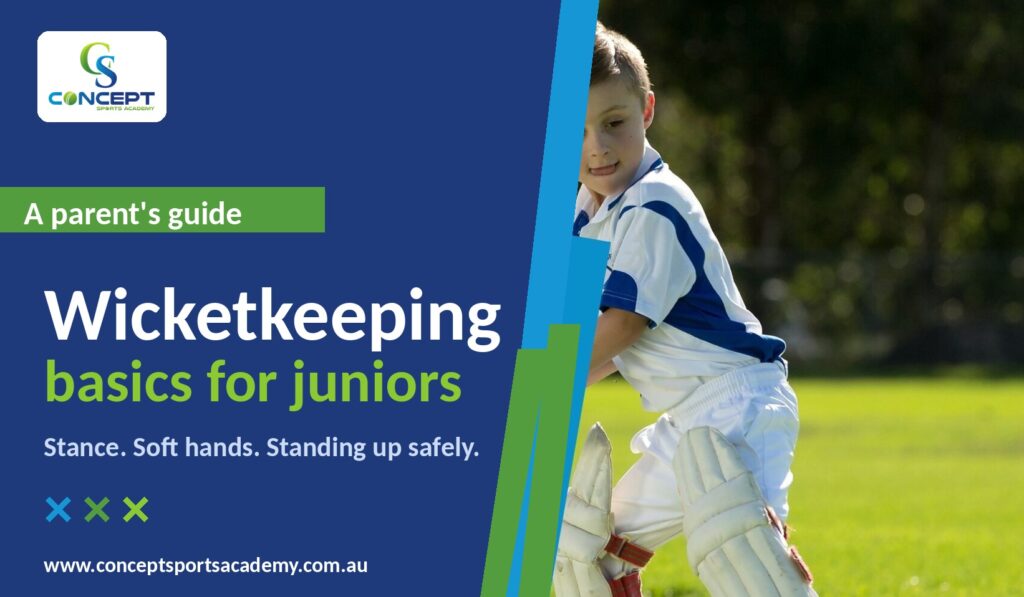
Most junior teams find their wicketkeeper the same way. Someone is asked at the first training session, nobody else puts a hand up, and a ten year old is handed a pair of oversized gloves. Sometimes that child turns out to love it. Often they spend a season being hit in the shins and wondering what they did wrong.
Keeping is the most involved job in cricket. The keeper touches the game on almost every ball, sees every batter’s weakness first, and has to stay switched on when nothing much is happening. It is also learned in a particular order. Get the basics in the right sequence and the position becomes enjoyable quickly. Skip them and it turns into a chore. Here is how it works for juniors, and what parents can do to help.
Start with the stance, not the gloves
New keepers tend to focus on catching, but catching is the result of a good setup. A sound stance means feet about shoulder width apart, weight on the balls of the feet, knees bent and the head still and level. The gloves sit in front, close together, ready to rise with the ball.
The common mistake is sitting too low and too far back on the heels. From there a keeper cannot move quickly in either direction, and the eyes end up looking up at the ball instead of level with it. A coach will usually ask a child to find a position where they could spring left or right without thinking about it. If they can, the stance is working.
Soft hands and feet first
The second skill is taking the ball cleanly. Soft hands means the gloves travel with the ball for a moment after contact instead of stopping dead, which stops it bouncing out. Fingers point down for balls below the waist and up for balls above it, and the eyes stay on the ball until it is in the gloves.
Movement matters just as much. Young keepers often reach for wide deliveries with their hands and leave their feet behind. The habit to build is feet first, hands second, so the body gets in line with the ball and the gloves finish the job. It looks slow at first, then becomes automatic with repetition.
Standing back or standing up
Against quicker bowling, a keeper stands back so there is time to see the ball bounce and take it at a comfortable height. Against slower bowling, a keeper can stand up to the stumps, which puts pressure on the batter and opens up stumping chances. Standing up is harder. The ball arrives sooner, edges come closer to the face, and the keeper has less room for error.
That is why most juniors benefit from learning to keep standing back first, and only moving up once their glove work is reliable. Safety is part of that decision. Cricket Australia’s guidance says a helmet meeting the BS7928:2013 standard is required for keepers standing up to the stumps in competitions it manages, and it strongly recommends the same in community cricket. Your club or league may have its own rules, so ask before the season starts. Our guide to common cricket injuries and how proper gear can prevent them covers the wider equipment picture.
Keeping to spin
Keeping to spin brings its own challenges, because the ball can turn, drift or stay low. The keeper has to read the bowler’s variations from behind the stumps. How a young spinner delivers the ball changes what arrives in the gloves, and our look at why young spinners bowl flat is useful background for any child who will be keeping to them.
What good practice looks like at home
Keepers do not need a net or a coach for every session. Short, regular practice beats one long effort. Ten minutes a few times a week is plenty, and a few simple activities cover most of what a young keeper needs:
- Throwing a tennis ball against a wall and catching it on the rebound, moving the feet to get in line.
- Dropping a ball from shoulder height for a partner to catch with soft hands, then adding a bounce.
- Rolling balls at an angle so the keeper has to move sideways before catching.
- Using a reaction ball, which bounces unpredictably, to sharpen quick hands.
Fit matters too. Gloves that are too big make fumbling almost certain, and pads that restrict movement make a crouch uncomfortable. If something looks too large, it probably is. A coach or experienced club member can check the fit in a minute.
The mental side of the job
Keeping is public. A dropped catch or a run of byes is visible to everyone, and children notice. The best thing a parent can do is respond to effort and communication rather than outcomes. Praise the call for the run out, the encouragement to the bowler and the willingness to keep going after a miss.
It also helps to treat the role as one of several. In the early years it is perfectly reasonable for children to rotate through keeping, fielding and bowling. A child who is allowed to try it without being locked in is far more likely to choose it later for themselves.
When to add structured coaching
Backyard practice builds familiarity, but a coach can spot small habits that become big ones, such as a head that drifts or a stance that sits too low. Our foundational training program is built for players aged 7 to 14 and covers the movement, hand-eye coordination and ball skills that keeping relies on. For players who already know they want to work on a specific role, our intermediate level program includes position-specific training.
The aim at this age is not to produce a specialist keeper. It is to give a child enough skill to enjoy the position and enough confidence to keep trying it.
Frequently asked questions
What age should a child start keeping?
There is no fixed age. Many children try it in their first or second season, and it is fine to do so as long as the gear fits and the coach is supervising. Focus on enjoyment and basic skills rather than specialising.
Does my child need a helmet to keep?
It depends on the competition and where the keeper stands. Cricket Australia requires a helmet for keepers standing up to the stumps in competitions it manages and strongly recommends it in community cricket. Check your club’s rules and ask a coach about the right fit.
Should keepers wear inner gloves?
Many do, because they add comfort and a little protection. Whether to use them is a personal choice, and a coach can help your child decide once they have tried the gloves in a session.
How often should a young keeper practise?
A few short sessions each week works better than one long one. Ten to fifteen minutes of catching and footwork keeps skills fresh without making the position feel like homework.
Is it better to keep wicket or play another position?
Neither is better. Young players tend to develop best when they try several roles. If your child enjoys keeping, encourage it, and if not, let them move on without any pressure.
Ready to see your young keeper in action?
| Book an assessment at Concept Sports Academy
If your child is curious about keeping, or you are not sure where their strengths lie, an assessment is a relaxed way to find out. Our coaches look at movement, hand-eye coordination and confidence, then suggest a sensible next step. Get in touch to book a time that suits your family. |