
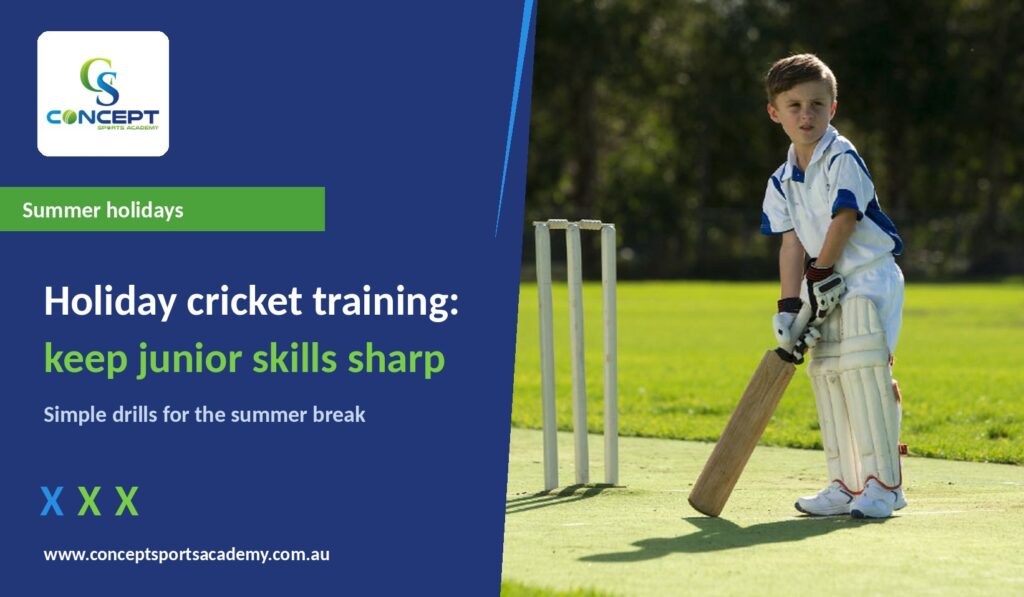
For most junior cricketers in Victoria, the season does not stop over summer, but the routine does. School finishes for the year on 18 December 2026 and government schools return in late January 2027. In between come Christmas, family holidays and a few weeks where club training often slows down or pauses altogether.
That break is a good thing. Young players need rest, and a few weeks away from the nets can leave them hungrier for the second half of the season. The challenge is coming back in late January without having lost the timing, rhythm and fitness they built before Christmas. This guide to holiday cricket training shows families how to keep skills ticking over during the summer break without turning it into a training camp.
Why the summer break matters
Cricket skills are built on repetition. A batter’s timing, a bowler’s run up and a keeper’s footwork all rely on movements being repeated often enough to become automatic. After several weeks without practice, those patterns do not disappear, but they can feel rusty, and the first few sessions back can be frustrating.
The aim over the holidays is not to improve dramatically. It is to keep the key movements familiar so that when proper training resumes, your child picks up where they left off rather than starting again.
Plan a little, not a lot
A simple weekly rhythm works better than an ambitious schedule that falls apart after Boxing Day. For most juniors, two or three short sessions a week is plenty. Twenty to thirty minutes of focused work beats a two hour session that ends in boredom.
It helps to write the plan down with your child and let them choose some of the activities. Ownership makes it far more likely they will actually do it, especially when friends are heading to the pool instead.
Build around family plans
If you are going away, pack a tennis ball and a soft ball. Many of the best holiday drills need nothing more than a wall, a patch of grass or a quiet stretch of beach.
Simple drills for the backyard
For batters
- Wall rebounds: throw a tennis ball against a wall and play it back with a straight bat, focusing on head position and a still base.
- Shadow batting: practise stance, back lift and a few key shots in front of a mirror or window, slowly and with good shape.
- Underarm feeds: a parent or sibling can feed balls from close range so your child can work on watching the ball onto the bat.
For bowlers
- Action without a ball: walk through the gather, front arm and follow through to keep the action smooth.
- Target practice: place a cap or towel on a good length and bowl short spells at it from a shortened run up.
- Keep spells short: stick to the workload guidance for their age, and stop when technique starts to slip.
For keepers and fielders
- Catching variety: high catches, low catches and reaction catches off a wall all keep the hands soft.
- Ground fielding: roll balls left and right so your child can practise getting low and moving their feet.
Fitness without the grind
Summer is a great time to stay active in ways that do not feel like training at all. Swimming, riding a bike, kicking a ball at the park or playing backyard games all help maintain fitness, agility and coordination. Variety also gives the body a break from the repetitive load of bowling and batting.
Melbourne summers can turn hot quickly, so plan sessions for early morning or evening, keep drinks on hand and take shade breaks. Our guide to junior cricket in hot weather covers what to watch for when the temperature climbs.
Where indoor training fits
One advantage of indoor nets is that sessions do not depend on the weather. On a scorching day or a wet one, juniors can still bat and bowl with consistent bounce in a controlled environment. A coached session or two during the break can also give your child specific things to work on at home, which makes backyard practice more purposeful.
For players who already have the basics and want to build on them, our intermediate level program focuses on refining technique and decision making. If you are not sure where your child fits, a skills assessment is a sensible starting point before the second half of the season. Families from Greenvale and nearby suburbs can reach our Craigieburn centre easily during the holidays.
Coming back in January
When club training resumes, ease back in. The first session or two should rebuild rhythm rather than chase speed or big hitting. Bowlers in particular should build their workload gradually after a break, as jumping straight back to full spells increases the risk of soreness.
Encourage your child to notice what feels different and talk about it with their coach. A short conversation early in the new term can save weeks of frustration.
Frequently asked questions
Should my child take a complete break over Christmas?
A week or two of complete rest is perfectly fine and often helpful. The aim is to avoid a long stretch with no activity at all, rather than to train every day.
How often should juniors practise during the school holidays?
Two or three short sessions a week is usually enough to keep skills familiar. Keep them fun and let your child have a say in what they work on.
What equipment do we need for backyard practice?
Very little. A bat, a tennis ball, a soft ball, a wall and a few markers or caps cover most of the drills that suit a backyard or park.
Is it safe to bowl in the backyard during summer?
Yes, with sensible limits. Keep spells short, follow the workload guidance for their age and avoid the hottest part of the day.
How can I tell if my child has lost form after the break?
Some rustiness in the first sessions back is normal. If timing or accuracy is still well off after a few weeks, ask a coach to take a look at their technique.
Keep the momentum going
| Start the new year ready to play
Our coaches can help your child keep their batting, bowling and fielding sharp over summer, and give them clear goals for the second half of the season. Get in touch to find a session that fits around your holiday plans. |