
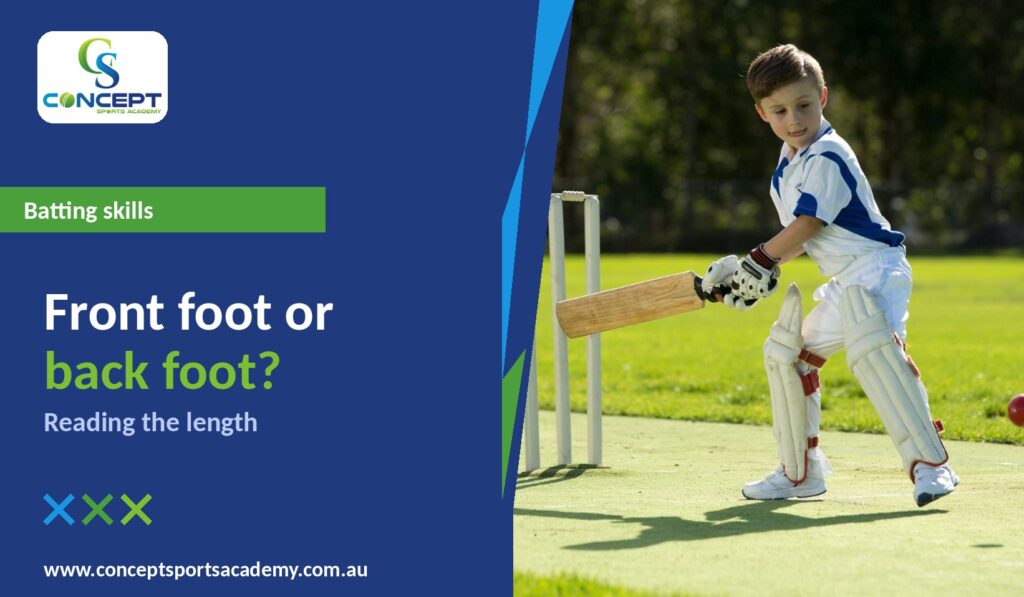
Every parent has seen it. A young batter takes a big stride forward to a ball that bounces much shorter, or stays back on a delivery that needed a step. The result is a mistimed shot, a top edge or a ball that sneaks through. The shot was not the problem. The decision came too late or went the wrong way.
This guide explains how young players learn to choose between the front foot and the back foot, what coaches mean by “length”, and how families can help practice at home without making it complicated.
What length actually means
Length describes where the ball bounces in relation to the batter. A full ball lands close to the batter’s feet. A short ball lands much further away, so it rises towards the body after it bounces. A good length sits in between, which is the tricky area where the batter is not sure whether to go forward or back.
Young players often hear the words “front foot” and “back foot” long before anyone explains the idea behind them. The idea is simple. Go forward to balls that pitch close, and go back to balls that pitch short. The skill is working out which is which, quickly.
Why this decision is harder than it looks
A batter has only a fraction of a second to read the ball. Experienced players start picking up clues early, such as the bowler’s release and the first part of the ball’s flight. Juniors are still learning to do this, and their legs, eyes and hands are all growing at different rates. It is normal for a child to get it wrong, and it is a sign of progress when they start to notice their mistakes.
Pitch conditions play a part too. A grass wicket, a synthetic strip and an indoor surface can all bounce differently, which is one reason many families like to mix their practice settings. Our comparison of indoor and outdoor cricket training looks at what each setting teaches.
Starting with a still head and a good set-up
Before footwork can work, the batter needs a steady base. The head should be still and level, the eyes looking at the bowler, and the weight balanced between both feet. A grip that feels comfortable and relaxed helps the hands stay ready, and our article on improving batting with the right grip is a helpful companion to this one.
A small movement just before the ball is released, such as a gentle press or a small step, can help a young player stay alive rather than rooted to the spot. Coaches teach different versions of this, so it is best to follow the advice of your child’s coach and keep the movement small.
The front foot: reaching the pitch of the ball
When the ball is full, the aim is to get the front foot towards the line of the ball and play with the bat close to the pad. Children often lunge, which leaves the head falling away and the bat swinging across the line. A shorter stride with the head over the front knee is usually easier to control.
A simple home drill
Stand your child a short distance away and toss a soft ball underarm so it bounces close to their feet. Ask them to step towards it and tap it back with a straight bat. Repeat ten times, then take a break. Praise the balance of the finish, not how hard the ball was hit.
The back foot: making time
When the ball is short, the batter goes back and across, giving the eyes extra time to see the ball rise. Staying back also helps a young player avoid being caught half way between the two options. The common mistake is to back away towards the leg side, which pulls the head off the line.
A simple home drill
Toss the soft ball so it bounces roughly halfway down the distance between you and your child. Ask them to step back towards the stumps and play it down with a soft grip. Avoid hard balls at home. Protective equipment and hard-ball practice are best handled with a coach.
Learning to choose between the two
Once each movement feels natural, mix them up. Call out “front” or “back” just after you release the ball, then slowly remove the call so your child makes the choice. This is a fun way to build the habit of reading the bounce rather than guessing in advance.
It also helps to talk about what the ball did after each attempt. Questions such as “where did it land?” and “what did you feel in your feet?” help children link what they see with what they do. Keep it light. Two or three short rounds are enough for one session.
What coaches look for
A coach watches the head position, the transfer of weight and the first movement of the feet. These small details are hard to see from the sideline, which is why a short assessment can make such a difference. Our intermediate level program works on footwork and shot selection for players who already have the basics, building decision-making in a controlled environment.
The goal at this age is not a perfect technique. It is a young player who is willing to watch the ball, make a decision and back it, even when it does not come off.
Frequently asked questions
How do I know if my child is better off going forward or back?
It depends on the ball, not the player. Balls that bounce close to the feet suit the front foot, and balls that bounce further away suit the back foot. A coach can help your child learn to read the difference.
Why does my child keep playing and missing on the front foot?
Often the stride is too long, or the head has moved ahead of the bat. Shortening the step and keeping the head still over the front knee usually helps.
Can children practise batting footwork without a bat?
Yes. Shadow practice of stepping forward and back, with the eyes on an imaginary ball, is a gentle way to build the movement pattern. Add the bat once the feet feel comfortable.
Is it normal for juniors to guess the length wrong?
Yes. Reading length is one of the harder batting skills, and it improves with time and exposure to different bowlers and surfaces.
What type of ball should we use at home?
A soft tennis-style ball is a sensible choice for backyard practice. Hard cricket balls are best introduced with a coach and the correct protective equipment.
Want help with your child’s batting footwork?
| Let our coaches take a look at your young batter
Good decisions at the crease come from practice in a safe, supportive space. Book an assessment and our coaches will watch how your child moves, then suggest a sensible next step for their batting. Reach out to find a time that suits your family. |