
When families ask about indoor cricket, they are usually asking one of two quite different questions without realising it.
The first is about indoor training: practising in nets under a roof, with a coach, working on technique. The second is about indoor cricket, the format, which is an actual game played on a netted synthetic court with six or eight players a side, a softer ball, and its own rules and competitions.
These are not the same thing, and they develop different qualities. Sorting out which one you are asking about is the first step to answering the question properly.
The Melbourne calendar makes this unavoidable
Cricket in Victoria is a summer sport, with the junior season running from around October to March. That leaves roughly six months where outdoor practice is difficult, and a good part of that window is when the most important development work should be happening.
Turf and synthetic outdoor nets become unusable or unpleasant for long stretches of a Melbourne winter. Grounds are wet, light disappears by late afternoon, and club nets are often closed entirely. A family committed to outdoor-only practice loses most of the preseason.
That matters because the build-up into a season determines how a child starts it. Bowlers in particular need a graduated increase in volume before round one rather than after it, and the shape of the Victorian junior season means that build-up falls squarely in the months when outdoor training is least reliable.
What indoor training genuinely does better
Some advantages of training under a roof are real and worth naming plainly:
- The surface behaves the same way every session, which makes it far easier to isolate what a player is doing rather than what the pitch is doing.
- No rain cancellations, no lost light, no unplayable ground. A planned twelve-week block actually happens.
- Repetition density. A bowling machine or a coached feed delivers far more balls in an hour than a match or a club net session ever will.
- Cameras and ball tracking work reliably in controlled light, which means a player can see what they did rather than being told about it.
For technical correction, this environment is close to ideal. If a batter is falling over to the off side or a bowler is losing their wrist position, indoor is where you find it and fix it, because everything else is held constant.
What indoor training cannot teach
This is where an honest answer matters, because the limitations are just as real.
A controlled surface removes variability, and variability is a skill in itself. Reading a pitch, adjusting to uneven bounce, working out whether a surface is doing something early, judging length on a wearing wicket: none of that can be learned where every ball behaves identically.
Outdoor cricket also involves an environment that indoor cricket simply does not have. Judging a high catch against a bright sky, dealing with wind on a bowler’s run-up, chasing a ball across a fast outfield, and running long distances between wickets on grass are all match realities that a net cannot reproduce.
There is also a scale issue. Indoor nets are excellent for batting, bowling and close catching. They are poor for outfield fielding, boundary work and genuine ground coverage, which need space.
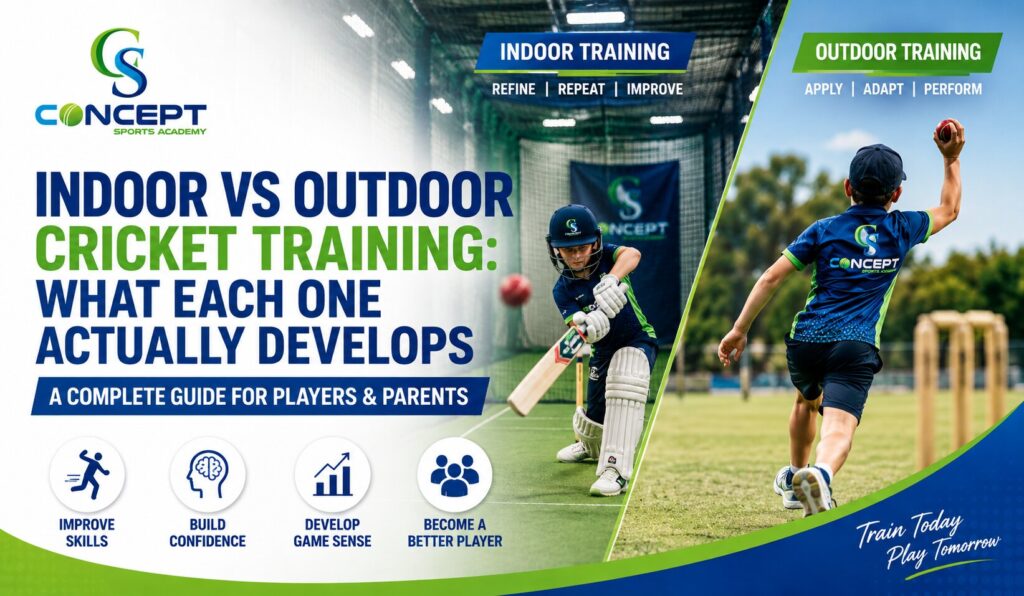
The correct conclusion is not that one is better. It is that indoor builds technique and outdoor tests it, and a player who only ever does one will have an obvious gap.
Indoor cricket as a format
Separately from training, indoor cricket exists as a competitive game in its own right and it runs when outdoor cricket does not.
In Victoria, indoor cricket competitions operate through the winter months as well as through summer, with junior divisions available at many centres. Cricket Australia runs national indoor championships including a junior event, and Victoria fields state representative indoor teams, so there is a genuine pathway rather than just social play.
The format is played with fewer players on a netted court, with a softer ball than the outdoor game. That last detail matters for parents: playing indoor cricket does not maintain a child’s comfort facing a hard ball, so it complements outdoor cricket rather than substituting for it.
What indoor cricket does develop very well is involvement. With small teams and a compact court, every player bats, bowls and fields constantly, which suits children who spend too much of an outdoor Saturday waiting for something to happen.
A sensible way to plan a year
For most junior players in Melbourne’s north, the shape looks something like this.
- Autumn and early winter: rest from cricket, play another sport, and work on general physical development rather than sport-specific skill.
- Mid to late winter: begin technical work indoors, low volume, focused on correcting whatever last season exposed.
- Late winter into spring: build volume progressively indoors so the body is ready for October, and add outdoor sessions as conditions allow.
- Season: play, with indoor sessions used for targeted maintenance rather than overhaul.
The autumn block is the one families most often skip. General strength and movement work does more for a ten-year-old than extra net sessions, and age-appropriate strength training for children is a better use of the off-season than trying to fix a technique flaw in July.
What to look for in an indoor facility
Not all indoor setups are equivalent, and the differences are visible if you know what to check. Ask what the pitch surface is, since a hybrid or quality synthetic surface behaves far more like turf than a basic mat does. Check there is genuine run-up length, because a bowler practising off a shortened approach is not practising their action. Ask whether the balls used indoors match what your child faces on a Saturday, as the choice of ball for practice versus matches changes what the session is actually training.
Beyond the facility itself, the usual questions about choosing a sports academy apply: coach qualifications, group sizes, and whether sessions are planned around the individual or delivered identically to everyone who walks in.
Indoor and outdoor are not competing options. They are two halves of a year, and the players who improve fastest are the ones using each for what it is actually good at.
FAQs
Will training indoors make my child worse at facing real bounce?
Not if the surface is a reasonable quality one and the child also plays outdoors in season. The risk exists with very basic mat surfaces that produce artificially low, consistent bounce, which can groove a batter into playing back to deliveries they should be coming forward to. Hybrid and good synthetic surfaces reduce this considerably, and any indoor work should be tested outdoors once the season starts.
Is winter training necessary, or should children have a complete break?
Both, in sequence. A genuine break from cricket after the season ends is healthy and reduces overuse risk, particularly for bowlers. What follows should be a gradual return rather than nothing until September, because arriving at round one undercooked is how young players get injured and lose confidence early.
My child plays another sport in winter. Can they still do indoor cricket training?
Usually yes, provided the total load across both is reasonable. One indoor cricket session a week alongside a winter sport is generally manageable and keeps skills ticking over. The thing to watch is a child doing two sports at full commitment plus extra training, which is where fatigue and overuse problems appear.
Does indoor cricket, the format, count as cricket experience for club selection?
It is viewed positively, but it is not a substitute for outdoor club cricket, since the formats differ substantially in ball, field size and tactics. Selectors for outdoor teams are looking at outdoor performance. Indoor cricket is best understood as something that keeps a child playing, involved and reacting through months when outdoor cricket is unavailable.
How many sessions a week is reasonable for a junior?
It depends far more on the child’s total commitments than on a general number, because club training, school cricket and matches all count toward the same total. A useful test is whether the child is still enthusiastic and physically comfortable after a few weeks at a given load. Enthusiasm dropping off is usually the first sign the schedule is too full.
Develop Your Skills. Build Confidence. Play Better.
| Come and see the surface before you decide
The honest way to judge an indoor facility is to stand in it. Watch how the ball comes off the pitch, look at the run-up space, and ask what the surface is built from. Any centre confident in its setup will be happy to show you rather than describe it. You are welcome to visit our Craigieburn centre and see the hybrid pitch and analysis setup for yourself. Call 1300 310 769 or email info@conceptsports.com.au to arrange a time. We are at 1/16 Poa Court, Craigieburn VIC 3064. Program details are at conceptsportsacademy.com.au. |