
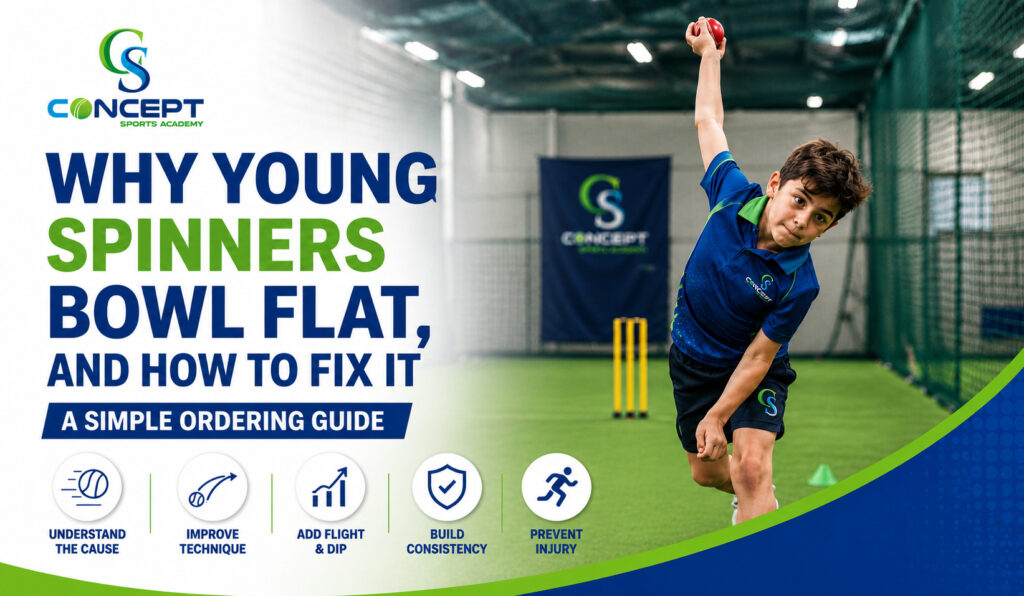
The ball that never leaves head height
Watch an under-13 game on any Saturday morning in Melbourne’s north, and you will see the same delivery over and over. The spinner runs in, the arm comes through quickly, and the ball travels to the batter in a flat line about stump high. It bounces once, does very little, and gets pushed into the covers for a single.
The bowler is not doing anything obviously wrong. The ball is on the pitch, it is roughly on target, and nobody has hit it for four. That is exactly the problem. Flat spin bowling looks safe and produces almost nothing, and because it never gets punished badly, it never gets corrected.
Almost every young spinner goes through this phase. The ones who become genuine wicket takers are the ones who get out of it early.
What flight actually does
Flight is not simply bowling slowly. Bowling slowly in a flat line just gives the batter more time to hit it, which is why coaches who tell a child to take pace off often make things worse.
Flight is about the shape of the ball’s path through the air. A delivery released with genuine revolutions and an upward trajectory climbs, holds for a moment, then drops. That drop is what beats a batter, because they commit to a length that the ball never reaches. The batter is not deceived off the pitch. They are deceived before it lands.
This is why revolutions matter more than turn at junior level. A ball that spins hard dips and drifts in the air even on a surface that offers nothing. A ball that is merely rolled out of the hand does neither, no matter how good the pitch is.
Why kids default to flat
The honest answer is fear, and it is a reasonable fear.
A flighted ball that lands short gets hit a long way. A flat ball that lands short gets pushed for one. In a format where a bowler might only get a few overs, and where getting hit feels public and embarrassing, a nine year old will choose the option that limits damage. They are optimising for not looking bad, which is a completely rational thing for a child to do.
This makes spin bowling a psychological skill as much as a technical one. A young spinner has to accept being hit occasionally as the price of taking wickets, and that acceptance takes time to build. It is closely related to how players learn to move past a fear of failure in competitive sport, and it usually needs an adult to say out loud that the boundary conceded while flighting the ball is a good ball, not a bad one.
If a child only ever hears feedback when they get hit, they will bowl flat. If they hear encouragement when they beat the outside edge and go for four next ball, they will keep giving it air.
The pitch length nobody accounts for
Here is something specific to junior cricket in Australia that changes the whole picture.
Under Cricket Australia’s junior formats, the pitch is shortened for younger age groups: 16 metres for under 10 and under 11, and 18 metres for under 12 and under 13, before moving to the full length from under 14. Confirm the current specifications with your club or the Cricket Australia community site, as formats are reviewed periodically.
For a spinner, this matters enormously. On a 16 metre pitch there is far less time for the ball to travel, climb and drop, so flight has less room to work and a good length sits much fuller than a child expects. Then the pitch gets longer twice in four years.
A spinner who has grooved a length on a shortened pitch will suddenly find it landing well short of where it needs to on a full pitch. This is the point where a lot of promising young spinners lose confidence and flatten out permanently, because nobody explained that their length simply needs recalibrating. It is a change in the environment, not a loss of ability.
Grip, ball and the practical stuff
Give a young spinner a ball they can actually grip. Junior formats use a lighter ball for good reason, and a child struggling to hold a full-weight ball across the seam will compensate with a wrist position that limits revolutions. The differences between cricket ball types and their uses are worth understanding here, because a softer or lighter ball at training is not a lesser option for a developing spinner; it is often the right tool.
Beyond that, keep the technical instruction minimal. Two things are enough for most young spinners: spin it hard, and land it in a repeatable area. Variations should wait. A child who has a doosra but no stock ball has nothing, whereas a child with one ball they can land six times out of six has a career ahead of them.
Where progress actually happens
Spin develops through volume of quality repetition, which is difficult to get in a two hour Saturday match where a bowler might send down four overs. Our intermediate level program gives spinners the repetition and the feedback loop that match cricket cannot, in conditions that do not depend on the weather.
One advantage spinners have over quicks is that their workload is far less restrictive. The guidelines that limit junior pace bowling volume exist because of the load fast bowling places on a growing spine. Spinners can bowl more often, and that extra repetition is a genuine long-term advantage if it is used well.
The young spinner who gets hit for four in October and keeps flighting it is usually the one taking five wickets in February.
FAQs
What age can a child realistically start learning spin?
As soon as they can grip the ball comfortably, which for most children is around seven or eight with an appropriately sized ball. Early spin work should be about feeling the ball come out of the hand with revolutions rather than about accuracy. Accuracy follows once the release feels natural, and children who learn to spin hard first tend to develop control faster than those taught to aim first.
Should my child learn off spin or leg spin first?
Let them try both and follow what feels natural, because the finger and wrist actions are quite different and most children have a clear preference within a few sessions. Leg spin is harder to control and takes longer to become effective, so a child who chooses it needs more patience from everyone around them. Off spin produces results sooner. Neither is a better long-term choice.
My child gets hit whenever they give the ball air. Should they just bowl flatter?
Not as a permanent solution. Being hit while flighting the ball usually means the length is wrong rather than the flight itself, and the fix is adjusting where the ball lands, not lowering the trajectory. A spinner who flattens out to survive becomes very difficult to score off and very difficult to take wickets with, which is a poor trade at junior level.
Is indoor training useful for spinners, or do they need turf?
Indoor training is particularly good for spinners because the two things that need the most repetition, release and landing area, do not depend on the surface. Consistent conditions actually make it easier to isolate what the bowler is doing, since the ball behaves the same way every time. Turf work matters later, when a bowler is learning to read what different surfaces offer.
How long before a young leg spinner develops proper control?
Longer than most families expect, often two or three seasons of consistent work before a leg spinner can reliably land the ball where they intend. This is normal and not a sign the child has chosen wrong. The wrist action involved is genuinely difficult, and the players who stick with it through the inaccurate years are the ones who end up with a skill very few bowlers have.
Build Your Cricket Skills with Expert Coaching
| See what your child’s stock ball is actually doing
Spin is difficult to coach by eye, because the things that matter most, revolutions and seam position, happen too quickly to see clearly. Our Craigieburn centre uses video analysis and ball tracking so a young spinner can watch their own delivery frame by frame and understand exactly why one ball gripped and the next one skidded on. Talk to our coaching staff about a spin bowling session. Call 1300 310 769 or email info@conceptsports.com.au. We are at 1/16 Poa Court, Craigieburn VIC 3064. Program details are at conceptsportsacademy.com.au. |